
55-Gallon Drum Safety: OSHA Guidelines & Equipment Solutions
Introduction
Handling 55-gallon drums is a daily task in many industrial and manufacturing facilities. A full drum can weigh 400–800 lbs, making manual lifting risky and a leading cause of back and musculoskeletal injuries [1][2].
While OSHA does not prescribe a step-by-step method for moving drums, it requires employers to identify and control material-handling hazards [3]. Combining OSHA compliance with best practices and the right equipment ensures a safe, efficient workplace [1][4].
OSHA Guidelines for Drum Handling
Key OSHA requirements include:
Minimizing exposure to heavy-load handling hazards and musculoskeletal injuries [3][5]
Providing proper training and personal protective equipment (PPE) [1][4]
Inspecting drums before moving, especially when hazardous substances are involved [6]
Using safe and feasible methods for lifting and transporting heavy drums [1][3]
OSHA does not set a specific weight limit for manual lifting [5], so mechanical aids are strongly recommended [2][7].
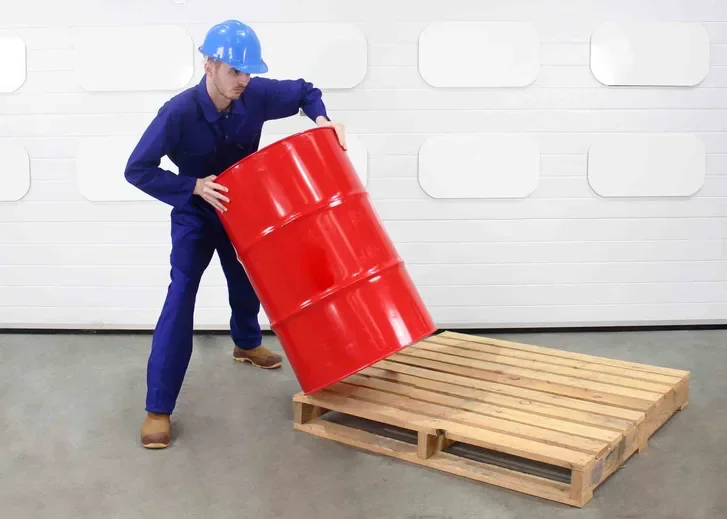
Improper Handling

Proper Handling
The Lever Bar allows repositioning with minimal effort
Best Practices for Safe Drum Lifting and Moving
1. Use Mechanical Drum Handling Equipment
Manual lifting of full drums should be avoided whenever possible. Tools like lever bars, drum trucks and cradles, drum lifters, drum rotators, and drum mixers reduce risk and improve efficiency [2][7].
2. Inspect Drums Before Handling
Check for leaks, damage, or unmarked chemicals. Proper inspection prevents spills, exposure, and accidents [6].
3. Train Staff in Proper Lifting Techniques
For empty or light drums:
Bend at the knees, not the back
Keep drums close to the body
Use team lifts when necessary [2][7][8]
4. Use Proper PPE
Depending on drum contents, provide gloves, steel-toe footwear, eye protection, and chemical-resistant clothing [1][6].
5. Plan the Drum Route
Clear pathways and map your route in advance to prevent trips, collisions, and injuries [2][7].
Why Lever Bars, Drum Lifters, and Other Tools Matter
Mechanical drum-handling tools improve safety and productivity:
Drum Lifters & Movers: Move heavy drums safely with no operator strain
Drum Rotators: Lift, Rotate and pour contents without manual effort
Drum Mixers: Mix drum contents safely while operator is protected
Lever Bars: Allows drums to be repositioned with minimal effort reducing back injuries.
Drum Cradles: carefully rotate drums onto their side for dispensing
Drum Trucks: Can safely transport drums without the need to roll or lift.
These tools help facilities stay OSHA-compliant while reducing back injuries and lost productivity [8].
Creating a Safe Drum-Handling Program
A comprehensive drum safety program combines:
OSHA-aligned safety procedures
Training on lifting and manual handling
Use of mechanical drum-handling equipment
Routine inspections and hazard communication
Proper PPE [1][2][3][7][8]
Facilities that adopt these practices protect employees, reduce injury rates, and improve operational efficiency.
References
OSHA. Materials Handling and Storage (OSHA 2236). [Link]
NIOSH. Ergonomic Guidelines for Manual Material Handling. [Link]
OSHA. 29 CFR 1910.176 – Handling materials — general. [Link]
OSHA. Ergonomics Overview. [Link]
OSHA. Interpretation: Manual Material Handling – No Weight Limits. [Link]
OSHA. Hazardous Waste Operations and Emergency Response Standard (29 CFR 1926.65). [Link]
CCOHS. Manual Materials Handling (MMH) – Drums and Barrels. [Link]
BMJ Musculoskeletal Disorders. Manual handling of heavy loads and low back pain among different occupational groups (2021). [Link]